-
Opinion | Features
Disclosure in Social Media: How transparent should bloggers be?
In this guest post, blogger and digital creative Laura McWhinnie argues for more disclosure in the bloggersphere.
The bloggersphere has always been a bit like the Wild West. Bloggers could post about products to their heart’s content without having to disclose their relationship with the brand. This meant that consumers had no idea who was behind the marketing messages influencing their purchasing decisions. But in 2009 that all changed
Liars, cheats and thieves
Is our industry full of cheats and liars or do people of honour who stand by their word still exist in business? In an article that first appeared in Encore, Cameron Boon investigates. The recent court case involving Paul Fishlock suing his former employer The Campaign Palace brought into focus more than just the struggle of one man. It highlighted that there are some in adland whose word cannot always be relied upon.
Q&A with Adshel's Rob Atkinson
Online trading is the next big thing says Rob Atkinson in a piece that first appeared in Encore. Who is the most powerful person in Australian media and why?
Harold Mitchell because of his influence and the footprint he has left. He’s built a huge brand in Mitchells, offloaded it into Aegis, Aegis has obviously done extremely well to be then sold on to Dentsu. So if you think about it, he is very much a father figure of the industry.
Making it overseas
Is the best way of being successful in Australia not be here at all? In a feature that first appeared in Encore, Lee Zachariah speaks to Aussies making it big abroad.I always wanted to work in New York,” says Julian Cole. “I thought it was the number one place to work in advertising; a lot of the best campaigns were coming out of there. So I moved over and was lucky enough to have a couple of interviews in the first couple of weeks.”
Cole’s story is indicative of the somewhat contentious idea that the best way to be successful in Australia is to not be in Australia any more.
Got a book in you?
From journos to ad execs and PRs, these days everyone seems to have a book in them. But what does it take to get published and will you actually make any money? In a feature that first appeared in Encore, Brooke Hemphill finds out.Attention wannabe authors. Forget big fat advance cheques and living off royalties. The reality of having a book published today is another story altogether. There are only two reasons you should even consider sitting down at your computer to bash out a manuscript – passion or profile.
Savage counsel
In an article that first appeared in Encore, Chris Savage tackles your career and agency dilemmas in his weekly advice column.Hi Chris,
My clients seem to be demanding more and more from us. At the same time, it seems many of the younger people in our industry simply don’t have the client servicing skills my generation grew up with. How do we instill in our executives some of the good old-fashioned behaviours that would keep a client happy and loyal?
Fake it til' you make it... as an ad agency receptionist
From dressing the part to playing the gatekeeper, Leo Burnett Sydney’s Susie Henry tells us how to make it as the face of adland in a piece that first appeared in Encore.What does a receptionist in an ad agency actually do?
Well, there’s the frantic every-day, all-day stuff of deliveries, courier bookings, doing expenses for directors – always challenging – plus arranging all the travel. But one of my main jobs is counselling the account service people. I also keep up with all sports information to discuss with our sports-loving clients – because who wants to be bored while they’re waiting? And I know how they like their coffee. You need to know everyone – from accounting to HR. I’m also the go-to for all catering and sending flowers.
Whose views skew the news? Media chiefs ready to vote out Labor, while reporters lean left
Most journalists lean left-of-centre, says Folker Hanusch of the University of the Sunshine Coast, in a post first published on The Conversation.Most Australian journalists describe themselves as left-wing, yet amongst those who wield the real power in the country’s newsrooms, the Coalition holds a winning lead.
But while the media’s political leanings will no doubt be debated in the lead-up to September’s federal election, our study has also found other largely unscrutinised biases remain – particularly whose views disproportionately shape the news.
It's time for a new New Wave in the film world
Government funding bodies are lazy and decadent, says industry veteran Michael Thornhill but in a piece that first appeared in Encore, Ed Gibbs begs to differ.I vividly remember the time I first saw Animal Kingdom, David Michod’s breathtaking labour-of-love feature debut. The press screening was half empty, despite the film winning the Grand Jury Prize at Sundance just months earlier, in 2010. Yet its superb performances, stylistic flourishes and overall polish left me speechless. Could this really be a feature debut, an Australian one at that, I wondered, almost out loud? It seemed too good to be true.
Going cold turkey on an agency addiction
Life is sweet for freelance writer Max Kitchen, but in a feature that first appeared in Encore, he admits his struggle against returning to the agency fold.I’ve never taken heroin. But I suspect if I had, the temptation to try it again would not be too dissimilar to the lure of returning to agency life.
Can sport save Ten?
First there was the Grand Prix. Next came the reported $500m bid for cricket rights, then Ten secured the 2014 winter Olympics. So, can sport save the ailing network? In a feature that first appeared in Encore, Nic Christensen investigates.The television sports rights bidding process is a bit like a game of poker.
Check, fold or bet. Those were the options for the Ten Network last week when it had to finalise its bid for the cricket rights.
Andy Lark: good for the marketing of marketing
I can still remember the first story I wrote about Andy Lark, when it emerged that he was to be the new chief marketing officer of CommBank.
It was immediately clear that Australia was about to meet an interesting marketer, one who blogged and tweeted and thanks to his time at Dell in the US was digitally savvy. Even two years ago, that was a big deal. The fact that he also had a stint in public relations gave him an absolutely intriguing background before he even arrived.
Storming the media barricades - advice for young journalists
This week Mumbrella’s Nic Christensen, who began his career four years ago, gave the keynote address to would-be journalists at the Media, Entertainment & Arts Alliance’s Student Day. This is an edited version of his speech.Good afternoon, I can remember distinctly the last time I was in this room.
It was 2009 and I was sitting where you are. I’d come to this event, a friend and myself — from memory we sat up the back — and I can remember at the time wondering if I’d ever get a job as a journalist.
It was only four years ago and then as now getting a job was ultra competitive but I’m not sure there was quite as much media ‘doom and gloom’ as there is now…
Paywalls will help fund campaigning journalism
In this guest post, News Limited’s group editorial director Campbell Reid responds to the views of ninemsn’s Hal Crawford that the company’s push into metered paywalls is about data rather than dollars.Hal Crawford is both right and wrong in his article which argued that our digital subscription plans are all about the data.
Fake it 'til you make it... as a features editor
Cosmo’s Kate Leaver tells us how to bluff it in her job in a feature that first appeared in Encore.What do you do, as a features editor?
Really, play with words and ideas all day. At any one time, we’re working across three issues of the mag – getting one on its way to the printers, pooling all the words together for another, and planning the issue after that. It’s busy but it’s a pretty magnificent process.
Social media agency slams Facebook benchmarks as ‘rubbish’, launches new benchmarks

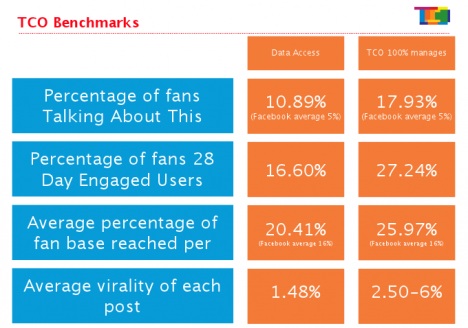
Content and social media agency The Conscience Organisation has released what it claims are Facebook marketing benchmarks the industry should be adhering to.
The figures are, according to TCO, a measurement of Facebook community management success.
Founder Clive Burcham told Mumbrella: “TV has ratings, magazines have circulation figures and IAB has figures for digital, but there’s no benchmark in social other than those created by Facebook itself and agencies setting their own for clients, which are generally rubbish.”
“We need some formality and rigour across the industry to deal with snake-oil salesmen and help clients get more bang for their buck. It’s a nuanced tactical environment. We’re all learning and those learnings change every few months. It’s time to let the cream rise to the top.”
TCO’s standards suggest that use engagement should range from 16.6% to 27.2%, and percentage of fans talking about a brand should range from 10% to 17%, compared with a Facebook average of 5%.
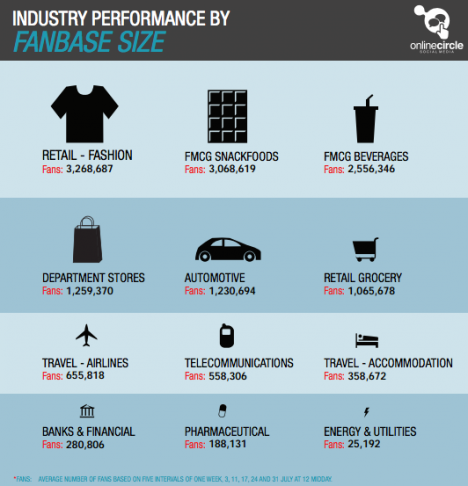
The figures have been released at the same time as Online Circle’s engagement figures for July.
The report rates engagement by sector, with banks and finance rating highest.
- Banks: 8.6%
- Trave- accomodation: 7.2%
- Retail grocery: 5.1
- Energy / utilities: 3.8%
- Department stores: 3.7%
- Retail / fashion: 3.4%
- Automotive: 3.3%
- Travel – airlines: 2.8%
- Pharmaceutical – 2.2%
- FMCG snackfoods: 2.1%
-
-
Email Newsletter
-
Follow @mumbrella
-
-
Dr Mumbo
Latest Comments
- Joffa on Cadbury defends its new ‘generous blocks’ Joyville campaign
- Stilgherrian on Disclosure in Social Media: How transparent should bloggers be?
- Anonymous on MediaMotive appoints group sales manager
- Crimarkable on Offspring returns with just 868,000 viewers but good numbers in key advertising demographics
- Benji on Making it overseas
- Sue on Anti-handgun campaign targets matriarchs of crime families
- Davy Wavy on Pink Media Group buys 40 per cent stake of gay radio station
- Louise on Disclosure in Social Media: How transparent should bloggers be?
Latest Jobs- Account Manager – Top Media Agency – To $80 package
- Client Service Manager – Fantastic Media Agency – To $80 package
- Business Development/Marketing Manager – Consumer Tech Experience – $100-150k
- Top Jnr to Midweight Creative Team
- Digital Copywriter with big thinking
- Super Art Director/Copywriter Team with 360˚ thinking
- Junior Community Manager | Sensis | 6 months contract
- Mid Level PHP Developer- Creative- Up to $67K + Super Ref 6488
- Account Executive
- Communications Manager
F.Y.I.
- Seven scores soccer rights for July
- MediaMotive appoints group sales manager
- Insurance Council of Australia partners with icon.pr for national financial literacy campaign
- mX to launch smartphone app
- Buchan Consulting appoints Gemma Hudson
- Pandora extends social experience with Facebook timeline app
- OMD and Mitchell & Partners retain WA Government campaign advertising services contract
- PPR wins Zumba public relations account
Most Discussed
- 7-Eleven says no to coffee snobs
With 63 comments - British PM has sex with pig in ad campaign for Foxtel's arts channel Studio
With 51 comments - An answer for Adam: What's the future for creatives?
With 34 comments - Encore on tablet: ‘massive mistake’ or ahead of the curve?
With 34 comments - Dualis sunroof leads to relationship breakup in new Nissan ad
With 34 comments - Foxtel apologises for 'lapse of judgement' over bestiality billboard and takes it down
With 32 comments - Media agency Digital Stars revealed
With 31 comments - Niche magazine titles challenged by agencies: Prove your worth
With 31 comments
- 7-Eleven says no to coffee snobs
-
RSS


Comments
22 Aug 12
11:37 am
what does any of this stuff even mean?
The TCO benchmarks are straight biz dev – wheel them out in a preso and ask a client ‘what is your agency generating’. Smart.
The Online Circle ones don’t mean anything at all.
To measure engagement you generally have to understand what it means.
22 Aug 12
11:42 am
Speaking of Facebook, how do we remove that annoying pop up when reading Mumbrella?
22 Aug 12
12:13 pm
The methodology behind those metrics seems faultless.
22 Aug 12
12:14 pm
fine with me as long as TCO offers a money back guarantee if any of its work fails to meet its own benchmarks
22 Aug 12
12:18 pm
Props to TCO for effectively creating a pitch platform. While I agree SM should consider industry-wide standards of behaviour and measurement, between this and the Communications Council’s Social Media Guidelines, I’m left wondering how we (those working in this area) can take ourselves seriously…
“It’s a nuanced tactical environment”. Bang on, Clive. Perhaps moving past ‘engagement’ figures and ‘sector benchmarks’ might help bring some credibility and industry standard to weed out the snake oil sales men (and women)?
22 Aug 12
12:31 pm
Agree Esther. That pop up means it does not work at all on a iPhone.
22 Aug 12
12:38 pm
Wouldn’t a metric of how facebook actually contributed to sales be more illuminating – creating a new language that encourages you to increase doing something that has no tangible result seems like snake oil sales (or religion) to me.
just sayin….
22 Aug 12
12:58 pm
You can’t Esther.
Seriously good question though, they’re pissing me off. Why did I approve it?
22 Aug 12
1:19 pm
Esther couldn’t agree with you more about that annoying pop-up. Almost as annoying as disabling the Back button on your site.
22 Aug 12
1:22 pm
I love the pop up. What’s so annoying about it? New York Times does it as well – and normally it’s right on the money in suggesting stories I’d be interested in.
22 Aug 12
1:35 pm
Both are a load of BS.
They are influenced by paid advertising. Very easy to get a high ‘people talking about’ % when you’ve been sinking $$$ into cheap ‘like’ ads.
I ask you, how on earth do you know creative is working if your measuring against a variable such as fan base?
All an engaged user is is someone who has liked your page, or had an interaction with content. It gives you a broad spectrum of page health, nothing more.
Want a true figure? then you need to get into the hard data that’s available. You need to look at your CONTENT, not the page as a whole. There are two data sets for each, both telling a different picture of what’s going on. But wait a second… it also helps you stay on strategy for your creative.
Content interactions Vs Content impressions – not influence by advertising, takes into account reach and frequency. Gives you a nice percentage..or engagement rate.
Clive Burcham says that agencies are setting their own benchmarks which are generally ‘rubbish’. Well sir, look at your own garbage.
I really hope brand managers are not paying heed to this article and no damage is done. It’s hard enough educating people about the importance of real data and accountability without this crap being spouted.
22 Aug 12
1:45 pm
Adblock works on it, Esther. I wouldn’t block it if it didn’t pop up every single time with all of the stories I’ve already read!
22 Aug 12
1:48 pm
Esther, the only way to do that is not be logged into Facebook with the same browser that you’re using to view Mumbrella.
P.S. Got a job for me?
22 Aug 12
2:13 pm
HA! Love the subtlety of delivery RR. Outstanding.
Mumbrella can you please send me a rate card for these advertorials? Do you do in house creative too? If so, just flick on another column and chuck a few points on top of TCO’s made up, made up stats.
Oh, and average ‘virality”? Love, Love LOVE that shit. My two year old makes up words too.
22 Aug 12
2:57 pm
Hi,
We’ll be removing the Facebook recommend pop-up very soon. Readers that hate it seem to far outweigh those who don’t- thanks for letting us know.
Cheers,
Cathie – Mumbrella
22 Aug 12
3:00 pm
Keen irony that he says the measures agencies come up with are rubbish given he came up with measures and he is an agency.
22 Aug 12
3:15 pm
@ Cathie McGinn
*Like*
22 Aug 12
3:53 pm
Standardised reporting available in real time means you can start measuring your return on investment (cost per conversion, engagement and transaction) Even edit your campaign in real time according to the data.
Stay Tuned!
22 Aug 12
4:16 pm
Show me the data and how it was cut. Not a slide from a pitch deck.
22 Aug 12
4:17 pm
Assuming these figures are based on TCO run pages – they would be largely local and not global sites. Facebook includes global pages which have much lower engagement rates due to fans spread across multiple time zones (and locally targeted posts). So, a nice idea for locally run pages, but to call Facebook numbers rubbish is, for lack of a better term, rubbish.
22 Aug 12
4:28 pm
TCO forgot to mention that they pay for their posts to appear in the newsfeeds of their fans. It’s not all organic and viral engagement. I see the little ‘sponsored’ icon next to a fair chunk of the Facebook posts from the most prominent page they manage.
Not making this clear seems like a ‘snake-oil salesmen’-type thing to do.
23 Aug 12
7:46 am
Looking forward to the day when someone can actually define engagement beyond its reference to an impending marriage
23 Aug 12
9:34 am
take the pop up off please!!!
23 Aug 12
9:55 am
Meausuring performance by fanbase size is just plain stupid. Hopefully this isn’t being peddled by agencies of any type. What seems to be missing in the whole industry is an appreciation of Meaning.
23 Aug 12
10:17 am
@Peter Bray
Spot on mate.
23 Aug 12
1:26 pm
Want a perfect example of “Likes’ on Facebook which don’t seem quite right?
Take a look at ScienceAlert which has 1.6million “Likes” – more than NASA.
This is a website run out of Canberra which recently managed to get $200,000 out of the Federal Govt.
Mind you – most of the “likes” come from Nepal…… just doesn’t add up to me.
23 Aug 12
1:44 pm
I love our attitudes of sledging people who are just having a crack at something. If you’re going to shoot someone down, do it constructively and suggest a solution. Don’t just bag them out. At least TCO is having a go.
24 Aug 12
11:45 am
Clive is absolutely right in the need for performance benchmarks. A number of people have already pointed out the issues with using “People Talking About”, namely media distorting the real level of engagement. And although you can’t separate organic from paid engagement (unless you have admin access) we need a more rigorous benchmark than People Talking About to measure how active a page is. Personally I prefer another interpretation of Engagement Rate. By taking the average total engagements (likes, comments & shares) for a post and then comparing that to total fan base you can strip out people liking the page counting towards engagement. You can see the Top 100 brand Facebook pages in Australia ranked by this interpretation of engagement here: http://www.slingshotdigital.co.....st-100.php. Although the Fast 100 can’t segment paid and organic engagement, it’s time to move beyond PTAT as a metric for success.
24 Aug 12
1:25 pm
Dividing engagement by the number of page fans still doesn’t work.
There is one crucial thing missing here – not every fan sees a page post.. in fact 16% on average see a post by the brand – 30%+ if the post is a good one.
Any engagement metric needs to take into consideration not only unique reach, but frequency. There are a number of ways a person can see a post on Facebook, Newsfeed is only one of them.
30 Aug 12
2:16 pm
That’s a good point Nathan, but how could you gauge the reach of competitor’s posts without admin access?
Measuring by frequency faces the same problem. If we had access to those figures it would certainly give us a far more detailed measure of engagement.
But with the data available, dividing engagement by fan page size still gives you a more nuanced view of how engaged a brand’s fan base is compared to PTAT.