
-
Opinion | Features
Disclosure in Social Media: How transparent should bloggers be?
In this guest post, blogger and digital creative Laura McWhinnie argues for more disclosure in the bloggersphere.
The bloggersphere has always been a bit like the Wild West. Bloggers could post about products to their heart’s content without having to disclose their relationship with the brand. This meant that consumers had no idea who was behind the marketing messages influencing their purchasing decisions. But in 2009 that all changed
Liars, cheats and thieves
Is our industry full of cheats and liars or do people of honour who stand by their word still exist in business? In an article that first appeared in Encore, Cameron Boon investigates. The recent court case involving Paul Fishlock suing his former employer The Campaign Palace brought into focus more than just the struggle of one man. It highlighted that there are some in adland whose word cannot always be relied upon.
Q&A with Adshel's Rob Atkinson
Online trading is the next big thing says Rob Atkinson in a piece that first appeared in Encore. Who is the most powerful person in Australian media and why?
Harold Mitchell because of his influence and the footprint he has left. He’s built a huge brand in Mitchells, offloaded it into Aegis, Aegis has obviously done extremely well to be then sold on to Dentsu. So if you think about it, he is very much a father figure of the industry.
Making it overseas
Is the best way of being successful in Australia not be here at all? In a feature that first appeared in Encore, Lee Zachariah speaks to Aussies making it big abroad.I always wanted to work in New York,” says Julian Cole. “I thought it was the number one place to work in advertising; a lot of the best campaigns were coming out of there. So I moved over and was lucky enough to have a couple of interviews in the first couple of weeks.”
Cole’s story is indicative of the somewhat contentious idea that the best way to be successful in Australia is to not be in Australia any more.
Got a book in you?
From journos to ad execs and PRs, these days everyone seems to have a book in them. But what does it take to get published and will you actually make any money? In a feature that first appeared in Encore, Brooke Hemphill finds out.Attention wannabe authors. Forget big fat advance cheques and living off royalties. The reality of having a book published today is another story altogether. There are only two reasons you should even consider sitting down at your computer to bash out a manuscript – passion or profile.
Savage counsel
In an article that first appeared in Encore, Chris Savage tackles your career and agency dilemmas in his weekly advice column.Hi Chris,
My clients seem to be demanding more and more from us. At the same time, it seems many of the younger people in our industry simply don’t have the client servicing skills my generation grew up with. How do we instill in our executives some of the good old-fashioned behaviours that would keep a client happy and loyal?
Fake it til' you make it... as an ad agency receptionist
From dressing the part to playing the gatekeeper, Leo Burnett Sydney’s Susie Henry tells us how to make it as the face of adland in a piece that first appeared in Encore.What does a receptionist in an ad agency actually do?
Well, there’s the frantic every-day, all-day stuff of deliveries, courier bookings, doing expenses for directors – always challenging – plus arranging all the travel. But one of my main jobs is counselling the account service people. I also keep up with all sports information to discuss with our sports-loving clients – because who wants to be bored while they’re waiting? And I know how they like their coffee. You need to know everyone – from accounting to HR. I’m also the go-to for all catering and sending flowers.
Whose views skew the news? Media chiefs ready to vote out Labor, while reporters lean left
Most journalists lean left-of-centre, says Folker Hanusch of the University of the Sunshine Coast, in a post first published on The Conversation.Most Australian journalists describe themselves as left-wing, yet amongst those who wield the real power in the country’s newsrooms, the Coalition holds a winning lead.
But while the media’s political leanings will no doubt be debated in the lead-up to September’s federal election, our study has also found other largely unscrutinised biases remain – particularly whose views disproportionately shape the news.
It's time for a new New Wave in the film world
Government funding bodies are lazy and decadent, says industry veteran Michael Thornhill but in a piece that first appeared in Encore, Ed Gibbs begs to differ.I vividly remember the time I first saw Animal Kingdom, David Michod’s breathtaking labour-of-love feature debut. The press screening was half empty, despite the film winning the Grand Jury Prize at Sundance just months earlier, in 2010. Yet its superb performances, stylistic flourishes and overall polish left me speechless. Could this really be a feature debut, an Australian one at that, I wondered, almost out loud? It seemed too good to be true.
Going cold turkey on an agency addiction
Life is sweet for freelance writer Max Kitchen, but in a feature that first appeared in Encore, he admits his struggle against returning to the agency fold.I’ve never taken heroin. But I suspect if I had, the temptation to try it again would not be too dissimilar to the lure of returning to agency life.
Can sport save Ten?
First there was the Grand Prix. Next came the reported $500m bid for cricket rights, then Ten secured the 2014 winter Olympics. So, can sport save the ailing network? In a feature that first appeared in Encore, Nic Christensen investigates.The television sports rights bidding process is a bit like a game of poker.
Check, fold or bet. Those were the options for the Ten Network last week when it had to finalise its bid for the cricket rights.
Andy Lark: good for the marketing of marketing
I can still remember the first story I wrote about Andy Lark, when it emerged that he was to be the new chief marketing officer of CommBank.
It was immediately clear that Australia was about to meet an interesting marketer, one who blogged and tweeted and thanks to his time at Dell in the US was digitally savvy. Even two years ago, that was a big deal. The fact that he also had a stint in public relations gave him an absolutely intriguing background before he even arrived.
Storming the media barricades - advice for young journalists
This week Mumbrella’s Nic Christensen, who began his career four years ago, gave the keynote address to would-be journalists at the Media, Entertainment & Arts Alliance’s Student Day. This is an edited version of his speech.Good afternoon, I can remember distinctly the last time I was in this room.
It was 2009 and I was sitting where you are. I’d come to this event, a friend and myself — from memory we sat up the back — and I can remember at the time wondering if I’d ever get a job as a journalist.
It was only four years ago and then as now getting a job was ultra competitive but I’m not sure there was quite as much media ‘doom and gloom’ as there is now…
Paywalls will help fund campaigning journalism
In this guest post, News Limited’s group editorial director Campbell Reid responds to the views of ninemsn’s Hal Crawford that the company’s push into metered paywalls is about data rather than dollars.Hal Crawford is both right and wrong in his article which argued that our digital subscription plans are all about the data.
Fake it 'til you make it... as a features editor
Cosmo’s Kate Leaver tells us how to bluff it in her job in a feature that first appeared in Encore.What do you do, as a features editor?
Really, play with words and ideas all day. At any one time, we’re working across three issues of the mag – getting one on its way to the printers, pooling all the words together for another, and planning the issue after that. It’s busy but it’s a pretty magnificent process.
Murdoch’s The Times switches on the pay wall
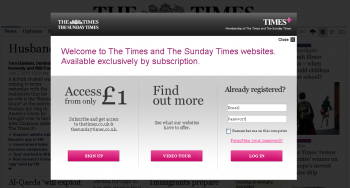
Rupert Murdoch’s pay wall adventure has begun.
The subscription page for News Corp’s London-based newspaper The Times has just been switched on.
The price – £1 for a day’s access or £2 for a week – was announced a few weeks ago.
Today the paywall was turned on, with readers being offered an initial special offer of £1 for a 30 day trial.

The Australian arm of the News Corp operation has also been uppping the pace in its race towards paid content online.
And The Australian has already launched its paid iPad app.
-
-
Email Newsletter
-
Follow @mumbrella
-
-
Dr Mumbo
Latest Comments
- Tex on Nick Cave provides soundtrack for moody Barossa Valley ad
- hmmm... on Nick Cave provides soundtrack for moody Barossa Valley ad
- AdGrunt on Fake it til’ you make it… as an ad agency receptionist
- Steve Fontanot on The Works take a Global Effie with the Devil’s Cut
- Abe on Nick Cave provides soundtrack for moody Barossa Valley ad
- mumbrella on House Rules fightback sees it outrate The Block for first time
- Lindsay. on Cadbury defends its new ‘generous blocks’ Joyville campaign
- Jean on AGL launches ‘do not knock’ sticker campaign while fighting legal battle against stickers
Latest JobsF.Y.I.
- Seven scores soccer rights for July
- MediaMotive appoints group sales manager
- Insurance Council of Australia partners with icon.pr for national financial literacy campaign
- mX to launch smartphone app
- Buchan Consulting appoints Gemma Hudson
- Pandora extends social experience with Facebook timeline app
- OMD and Mitchell & Partners retain WA Government campaign advertising services contract
- PPR wins Zumba public relations account
Most Discussed
- 7-Eleven says no to coffee snobs
With 63 comments - British PM has sex with pig in ad campaign for Foxtel's arts channel Studio
With 51 comments - An answer for Adam: What's the future for creatives?
With 34 comments - Encore on tablet: ‘massive mistake’ or ahead of the curve?
With 34 comments - Dualis sunroof leads to relationship breakup in new Nissan ad
With 34 comments - Foxtel apologises for 'lapse of judgement' over bestiality billboard and takes it down
With 32 comments - Media agency Digital Stars revealed
With 31 comments - Niche magazine titles challenged by agencies: Prove your worth
With 30 comments
- 7-Eleven says no to coffee snobs
-
RSS


Comments
2 Jul 10
3:55 pm
http://weblogs.hitwise.com/rob.....a_and.html has the figures for what happened when the register wall went up…
Market share has dropped from 4.37% during the week ending May 22nd to 2.67% last week (w/e June 19th).
Expect these numbers to drop even more dramatically.
2 Jul 10
4:08 pm
It’s Christmas for The Guardian
2 Jul 10
4:38 pm
…and in the ultimate irony, the headline on the front page of the website “Times paywall starts up with special offer” requires you to go through the paywall to read it!
2 Jul 10
4:44 pm
Tim
Your special offers link is broken
On the plus side, the 1 pound a day offer has NO MOBILE ACCESS
They much have an iPad app
2 Jul 10
5:17 pm
Shame, ’cause it was awesome. Probably the best news site in the world. Maybe I don’t get it, but surely having millions of people access your site and charging more for the advertising is a better model than having 3 people subscribe to it and no one look at the ads.
Anyways, The Times is the wrong site to charge for. Primarily it’s a news/sport/lifestyle site – stuff every site has. If it was a business site, with sharemarket information etc, etc, that was going to make the user money, I’d understand….
I can go to plenty of free sites to get the scores in the World Cup, thank you Mr Times….
2 Jul 10
6:30 pm
Hi Keith,
A fair question. But the issue is whether in the current market (or a future one) you can successfully charge advertisers to reach all of the people who stop by.
Ever expanding inventory and ever-declining cpms suggest not.
Cheers,
Tim – Mumbrella
2 Jul 10
9:00 pm
wtf is Hopkins on about ? The Aust was updating its site during the day starting with the first online editor Peter Wilson in 1999. As for the iPad feedback comments, he’s partially right: there has been a lot of feedback but about 80pc has been negative. Meanwhile Nick and editorial will continue their current level of influence over the amount of ad inventory and its placement – which is absolutely NO influence at all.
2 Jul 10
9:18 pm
Mr Mumbrella,
I’m truly humbled by the reply.
…. Interesting point. However, what’s the bet “The Times” is free again in 3-6 months’ time?
Anyway, it’s not free. It’s like commerical TV – I get to watch the content but I have to sit through the ads.
That said, websites are costly buggers to produce, so to be fair to Murdoch, why shouldn’t he charge for them?
The problem too for newspapers (in Australia) isn’t all the readers migrating online, it’s all the classified ads migrating online.
And there’s still plenty of life in print yet. I don’t see newspapers falling over any time soon. This may be slightly off the point but take the recently-launched Masterchef magazine, It sold 250,000 copies and had close to a mill in ads. Online just can’t match that! Saturday’s Herald with all its sections and magazine pisses on SHM.com
We recently saw the launch of the much vaunted ipad. I believe 150 Sydneysiders camped out over night to get one. 150 people? On the same day over a million Australians bought a print publication. Let’s not get too embroiled in the hype. Just yet anyway.
2 Jul 10
9:19 pm
PS As an experiment, Mumbrella should become paid subscription only. It’d be interesting to see how you fair…
3 Jul 10
6:58 pm
I clicked on to The Times the other day and was greeted with the pay wall. I just went to the Beeb. The BBC must be laughing. In the UK the TV licence funds their set up and for the first time (other than selling their content) they can sell ad’s on their own broadcast…
The Guardian, Telegraph, BBC and many more will gain numbers as The Times Online demises. We shall see though I might be wrong..?
5 Jul 10
2:42 pm
I second Keith. The Times’ content is too general and not niche or critical enough to get many subscribers at this stage. Maybe later, if and when most otter newspapers have gone paywall. But I doubt they all will.
Another, minor issue is the inward sense of revulsion at actually backing Murdoch with ones cash. Passively reading it for free is one thing, actively buying it quite another.
It’s like the Daily Mail: you find yourself reading it everyday, but you just can’t quite bear to bookmark it.
5 Jul 10
2:45 pm
The choice is Rupert’s to make – I suspect that the loss in revenue will not be too great from the online advertising, especially when you take into account the selling, running of that as well as how users probably would prefer less advertising.
1 paid reader is probably worth 500 non-paying – it would be interesting to see the revenue per unique visitor for similar sites over a monthly period.
Where Rupert has gone wrong, is to introduce this too soon – getting peoples’ email addresses with a simple signup form would’ve introduced a very valuable email database to market to, and almost certainly brought in a good revenue stream.
I don’t think I’d do it if it were my paper, but compulsory free registrations might still adversely affect traffic, but would give you heaps of revenue from those registrations (Times readers are Times readers, after all).
The other interesting aside is that they now appear to have blocked all search engine spiders, the articles that do show up will soon not. Meaning that they will soon have next to no presence on teh interweb, and the new user stream will dry up. It seems a shame that after building up that content, links and history to rank highly to turn it all off at night, and probably outweighs any advantage gained from revenue gained/lost by the change, at least in the longer term.
6 Jul 10
12:23 pm
http://www.shirky.com/weblog/2.....ss-models/
“Diller, Brill, and Murdoch seem be stating a simple fact—we will have to pay them—but this fact is not in fact a fact. Instead, it is a choice, one its proponents often decline to spell out in full, because, spelled out in full, it would read something like this:
“Web users will have to pay for what they watch and use, or else we will have to stop making content in the costly and complex way we have grown accustomed to making it. And we don’t know how to do that.””
7 Jul 10
2:25 pm
It is certainly a big experiment for Mr Murdoch and the results should be known within a few months. It can only be declared a success if The Times increases the overall revenue (ie. only if the sum of all revenue streams is greater than the current level). It may be a big challenge because the figures just don’t add up…
Gav, a couple months ago I did some investigations into revenues from printed vs online assets for Fairfax and I published results on my blog. The bottom line is that in order for paywall strategy to work access fees would have to be huge to cover losses from advertising revenue and/or online advertising revenue per visitor would have to jump several fold to just match current level of online revenue. The strategy will bring losses unless they can sign up millions of paying users… which is a very unlikely scenario (The Wall Street Journal, widely quoted example of pay-for-content success, has just over 1 million paying subscribers in the country with 307 million people). It turns out, the whole media game is exclusively about advertising revenue and not content…
http://all-things-spatial.blog.....ubles.html