


The Australian: Twitter will fail because it doesn’t create communities like newspapers do
The Australian has predicted that social networking site Twitter will fail despite the current buzz around it.
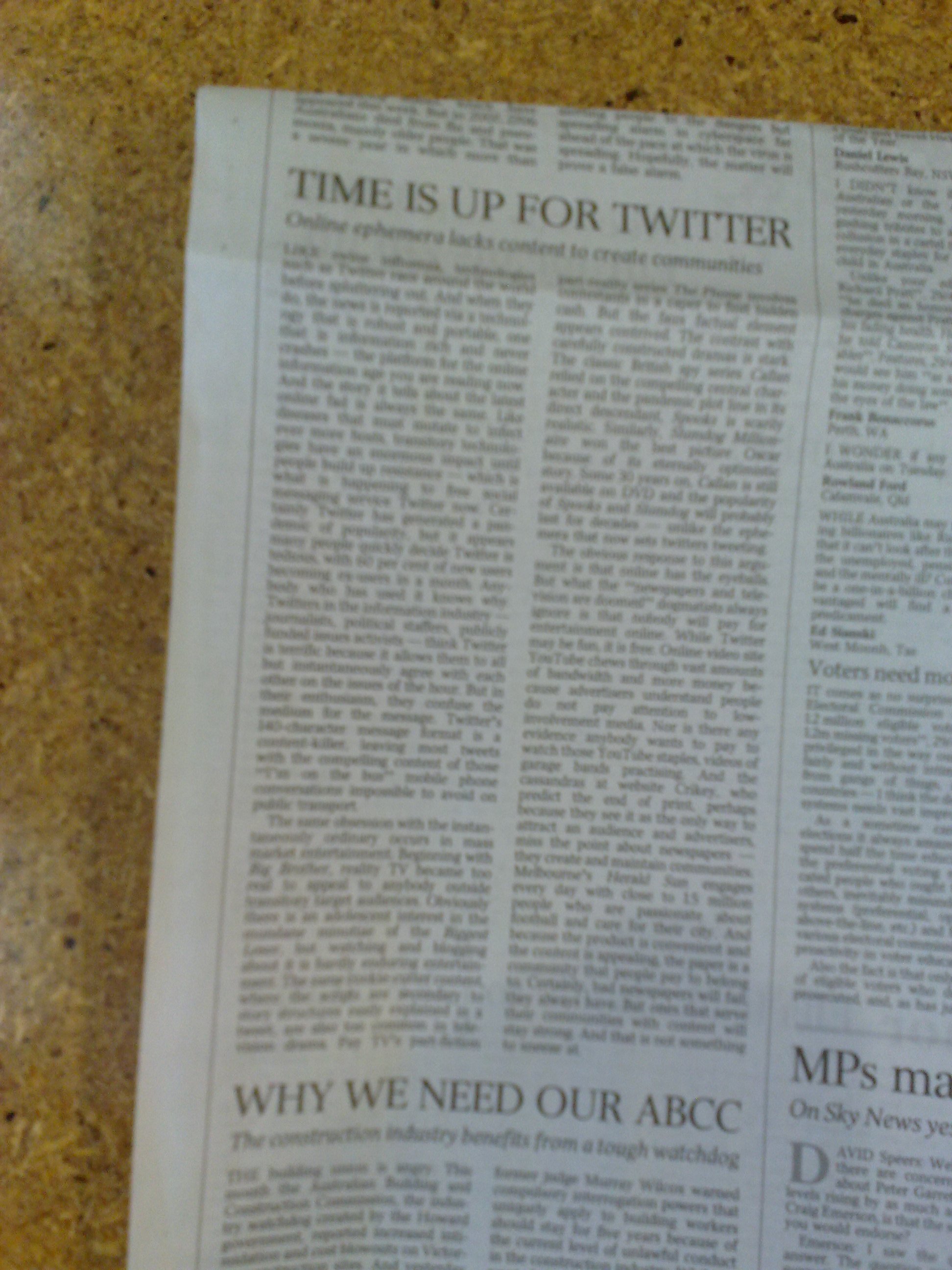
Behold: "the platform of the information age"
The newspaper dedicates one of its two main leader columns today to a lengthy piece headlined “Time Is Up For Twitter” suggesting that the social networking site is “spluttering out” because it “lacks content to create communities”.
According to the newspaper: “Certainly Twitter has generated a pandemic of popularity, but it appears many people quickly decide Twitter is tedious, with 60 per cent of new users becoming ex-users in a month.”
The paper also widens its attack on other media to reality TV and blogs, saying: “Obviously there is an adolescent interest in the mundane minutiae of the Biggest Loser, but watching and blogging about it is hardly enduring entertainment.”
And YouTube – owned by Google – also comes under the paper’s gaze, saying it “chews through vast amounts of bandwidth and more money”.
Instead, argues The Australian, newspapers are the enduring medium. It states: “Melbourne’s Herald Sun engages every day with close to 1.5 million people who are passionate about football and care for their city. And because the product is convenient and the content is appealing, the paper is a community that people pay to belong to.”
The Australian is owned by News Corp, which also owns MySpace and The Herald Sun.
Tim Burrowes founded Mumbrella in 2008. He worked on Mumbrella until 2021. At various points he was editor, content director and editor-at-large.
 Linkedin
Holy feck, Batman! Do they think their readers buy that stuff? That’s the funniest thing I’ve read in a newspaper in ages. It’s almost as if they were trying to write a charicature of how head-in-the-sand newspapers wish the world was. But I think they mean it.
They really do think that Twitter, YouTube and reality TV will die, leaving newspapers as the “platform for the information age” as they put it.
Brilliant. They really do get it, don’t they?
User ID not verified.
LOL
User ID not verified.
Their quoting of the 60% user abandonment and over-generalisation that most tweets fall into an “I’m on the bus” category are both flawed arguments.
There are lots of those people, sure. But there are lots who use it to engage with readerships and build communities. Yeah, really.
This just sounds like an out-of-touch publication having a whinge because they can’t be bothered to spend the time to properly understand a web service. Do they have a Twitter account?
By the way – is having 1.5 million readers who are passionate about watching men kicking balls around a field really a desirable asset?
User ID not verified.
The quality and thought and writing of the type of journalist that would use the word ‘pandemic’ now because his vocabulary has just been expanded by current affairs, this is an amusing article that will by no means be the last sputtering of the unreconstructed Luddites that fester away their last days in their paper empires.
User ID not verified.
Even though I am guessing we all know people who tried and gave up on Twitter, the Nielsen 60% stats are suspect, and the Second Life parallel that is being made is completely false (three reasons why Twitter isn’t like SL: http://bit.ly/r71dc)
Having said that, this has now been spread far and wide because it’s what, as you say, certain people *want* to hear. This is the story they’ve all been waiting for:
“Bunch of hype, what did I tell you, normal people don’t use it…anyway, let’s get back to what we were doing before”
User ID not verified.
They’ve certainly missed the point, haven’t they.
Perhaps someone needs to send The Australian a copy of this article – http://blogs.harvardbusiness.o.....ter_1.html
It provides a nice counter-argument to their position.
User ID not verified.
Have they told their employees, a few of which are listed at the following URL, that they’re wasting their time?
http://earleyedition.com/2009/.....n-twitter/
User ID not verified.
Twitter Pandemic Killing Communities; Newspaper Leads Link-Baiting Recovery
User ID not verified.
Surely they don’t actually believe any of what they said? Either that or it was written by a very old man who looked up every negative bit of press surrounding Twitter and then molded it into one grossly misinformed article. There are definitely some truths in it but you can’t argue that there is no “community”.
Someone needs to save this article and throw it back in the journalists face when the day comes when every paper is forced to have a twitter or other social network account to remain valuable to consumers.
I’m actually embarrassed for them!
User ID not verified.
its the OZ screaming “please dont let me die”
How could you expect them to understand, twitter it taking power out of the hands of journalists.
Is that a bad thing?
Maybe
User ID not verified.
I’m glad i don’t work for a Newspaper and have a huge mortgage…
User ID not verified.
Awe…trying to increase readers by criticising a popular topic that brings readers to the print and online platforms. So cute.
User ID not verified.
Talking of throwing stuff back, the Business Editor of Gulf News in Dubai once told a colleague of mine that he had “no intention of covering the Internet as it was a passing fad”.
His name was Chris Mullinger.
User ID not verified.
That’s the best picture caption I’ve seen in many a year.
User ID not verified.
Matt Dickman (i.e. Technomarketer) made a good point in that Nielsen only measured web traffic in their report on the 60% drop off rate in twitter (I can’t comment on if thats true or not – I haven’t read the report, I don’t plan on reading it). If that IS true, I’d say the report is completely useless, as most people graduate from the browser to a desktop or mobile phone client (excpet for me – I still love the old web interface)
User ID not verified.
It’s the typical head-in-the-sand approach from the News Ltd baby boomer management that inflicts pain across all their generation Y employees in Australia, whether they are at one of the big mastheads or in community papers. They just don’t do change well. They don’t get it. Which is a massive massive problem in the current newspaper climate.
I remember the big boss of News Community informing us all of an exciting slight change in font they had spent heaps of money researching to enhance readability. It was barely noticeable to the untrained eye. Maybe they should have spent more of that time and money on their online strategy?
When they finally let the next generation into management, hopefully they will finally embrace change. At the moment, yes, community papers are a big part of local communities. But, unless they move with the changes in how these communities are living, working and communicating, they will die out too, and possibly faster than Twitter…
User ID not verified.
weird … I thought the belief that digital and print channels couldn’t exist in harmony was limited to the digerati … now it seems the printerati are embracing the close minded approach too.
Is it April 1st?
User ID not verified.
just a thought, but aren’t the people who tweet “i’m on the bus” the same as the people who use the newspaper to line the bottom of the bird cage..?
User ID not verified.
Just the out cry that we expect from a medium that is quickly becoming extinct.
User ID not verified.
Hmmm … interesting.
Compare the view from The Australian with that of David Higgins, editor of news.com.au, from a recent interview in Media Week (2/3/09). He said:
“When you start replying to things people have said on Twitter, because you are in an individual discussion with every one of those people on Twitter, you have some pretty amazing experiences and contacts directly with your readers”
Assuming these feelings are mutual from the readers perspective, it sure smells like community spirit to me.
User ID not verified.
So much insecurity……wasn’t it just a few months ago that Twitter was the greatest thing since the printing press because it enabled a unique insight into what was happening during the terrorist attacks in Mumbai? We didn’t hear the print journalists attacking it so voraciously then did we?
When will they realise that this is one of the most exciting eras in the evolution of media communications? Digital technology is providing people with new, exciting, instantly accessible means of sharing information. These new means of communication are emerging so quickly, and people are becoming more adept at discovering them, trying them, and deciding whether they fit into their already busy, fragmented lives that higher rates of usage churn are inevitable.
Newspaper publishers should recognise the uniqueness of their position. They are generally amongst the oldest yet still most trusted media available. They are in a position to inform and educate their audiences about these exciting new opportunities and their relevance in today’s world. Why bag something like Twitter when they would probably gain more respect from their readers by extolling its usefulness?
User ID not verified.
I read the article and It just beggars belief on so many levels.
I like how it is referred to as online ephemera, because, you know, printed newspaper articles are so enduring, so easy to refer back to – never driven by the need to fill column inches.
And exactly how do you have a ‘pandemic of popularity’?
User ID not verified.
Crap article, but what’s with the obsession of calling the death knell of rival media sources? In reality, we’ll all still co-exist in 10 years. Newspapers will still exist, even if only in online format. So will TV and radio. And of course, so will all our favourite online channels.
We’re all Internet geeks, but that doesn’t mean the entire population will convert to our own ways of consumption. Others will continue to prefer TV, radio and other forms of ‘old media’, which will keep them alive.
User ID not verified.
Traditional media is still the best aggregator of mass audience available and “new” media provides unprecedented ability for consumers to interact with brands… it’s just that simple.
Every medium has strengths and weaknesses and therefor they have their respective uses, it’s media 1-0-bloody-1.
Could it be that traditional journalists are threatened by an increasingly popular technology which allows everyone to publish their thoughts?
Twitter will not replace newspapers. Newspapers will not replace (or replicate) social media. Audiences consume these different mediums for very different reasons.
Rant complete.
User ID not verified.
Wow, that’s really turned the tables, I’m convinced, will cancel my Twitter account immediately
User ID not verified.
How is Twitter going to die when people like this can’t stop talking about it? Is Twitter the Anna Nicole Smith of media?
User ID not verified.
Am torn
Twitter is rubbish of course, but news sites are only slightly less pointless now we can find anything we want
Am with Alexander though, love the use of pandemic here, which does seem to be getting a life of its own, I understand that the WHO are working on a vaccine for use of the word ‘pandemic’ which is now being transmitted between humans with no connections to Mexico…..
User ID not verified.
“Newspapers will still exist, even if only in online format”
Surely you can’t call an online newspaper a newspaper anymore.. if they no longer print it on paper wouldn’t you be forced to adopt a modern and more exact name for the medium… maybe we should call them “news:urls”
User ID not verified.
Just a note on the research – but making no comment on the way the article was reported (though Paddy, nice comparison re Mumbai!)
My understanding is that the research was based on the Nielsen Online Netview panel. I suspect that it is the US panel which is around 30,000 people from memory.
The original analysis was based on jus Twitter.com. The analysis was repeated using a grouping of 30 websites that feed into Twitter (TweetDeck, TwitPic etc). Over a period of a year the monthly retention rate PEAKED at 40% and varied between 20% and 40% over the past year. The good news is that it has been trending up for the ast four months.
I’d like to stress that this is ONLINE usage of Twitter and does NOT include mobile usage of Twitter. Clearly, Twitterers could be abandoning online Twitter for mobile Twitter, and most likely are as that is Twitter’s “native” environment.
I suspect that the report did not make this distinction clear enough. But the fact remains that every month for the past year between 60% and 80% of people who Tweeted online at least in a calendar month do not Tweet the following month. Online Twitter is hardly a “sticky site” with great retention. Mobile Twitter may well have great retention, and I am absolutely positive that among the Mumbrella readers it does, but then we may just be in the 20%-40% and not in the majority that we too often assume that we are.
Full Disclosure – no I don’t have a Twitter account.
User ID not verified.
zOMFGROFLBBQLOL
Demonstrating such a deep lack of understanding into the change in consumer/media behaviour… Gold…
This reminds me of the following:
# “I think there is a world market for maybe five computers.” — Thomas Watson (1874-1956), Chairman of IBM, 1943
# “Who the hell wants to hear actors talk?” — H. M. Warner (1881-1958), founder of Warner Brothers, in 1927
# “Heavier-than-air flying machines are impossible.” — Lord Kelvin, President, Royal Society, 1895
# “Everything that can be invented has been invented.” — Charles H. Duell, Commissioner, U.S. Office of Patents, 1899
# “Inventions reached their limit long ago, and I see no hope for further development.” — Julius Frontinus, 1st century A.D.
# “There is no reason anyone would want a computer in their home.” — Ken Olson, president, chairman and founder of Digital Equipment Corp., 1977
# “This ‘telephone’ has too many shortcomings to be seriously considered as a means of communication. The device is inherently of no value to us.” — Western Union internal memo, 1876.
# “”The wireless music box has no imaginable commercial value. Who would pay for a message sent to nobody in particular?” — David Sarnoff’s associates in response to his urgings for investment in the radio in the 1920s.
User ID not verified.
I think Anonymous 3:25pm summed it up best with “LOL”.
User ID not verified.
I agree. Twitter will not survive because the contacts created are not really important to users personally. Facebook has implemented the T-idea nicely on their new facelift, but Twitter needs to do something fast in order to survive. Maybe something with LinkedIn might work! But,…in the meantime,…Tweet me: http://twitter.com/KrisOlin
User ID not verified.
Newspapers are dying, so get a life. Look at the US model where newspapers are having to get on line to survive. With classified ad revenue down by 60% sice 2006, who are you kidding.
User ID not verified.
Mike. Just to clarify something re US newspapers (which are definitely in a world of hurt). The majority of US newspapers are still making an operating profit. What is cruelling them is interest payments. You have the situation where real-estate moguls like Sam Zell paid way over the odds for The Tribune Group thus crippling the business that he has been steadily stripping in order to service that debt. The primary problem in their business model is escalating debt which greatly overshadows their declines in classified revenue (which has been partly offset by their increases in online advertising and subscription revenue). The local newspapers are not crippled with over-leveraged debt and are in a much healthier position to concentrate on ‘monetising’ their on-line businesses.
User ID not verified.
John – and UK newspaper sales down some 12% over the past three years? The Sun sale down while its website is up to 28mn visits/month?
Twitter is dead! The Internet won’t affect us! The readers will always fly to quality!
Quality. The invariable last word of the disintermediated just before the darkness claims them…
User ID not verified.
Mike, totally agree that sales are down, as is ad revenue – they are undeniable facts. But in my opinion newspapers without debt still have life in them !
Looking at the Sun, it has around 3m copies sold a day and 8m readers a day. Yes, that is a day! (And highest sales was just under 4.9m back in 1995 when they cut the cover price to 10p for the day). At a 30p cover price I’ll call that near enough to 1m GBP a day – not too bad cash-flow for a dying dinosaur. A just a little perspective on the 28m visits a month to their website (an impressive figure) , that is not a ‘people-based’ figure but (probably) ‘unique cookies’ – an unduplicated figure over a month and one of the more meaningless metrics devised.
User ID not verified.
Before you all get too carried away dancing on the graves of the newspapers, has anyone else noticed that the triumph of the aggregated content machines will be somewhat hollow if there’s no content to aggregate. (apart from, god help us, “user generated”- surely the scariest two words since “self assembly”)
User ID not verified.
Pozlit, because all the journalists working for traditional newspapers will just go off and find other careers, rather than moving to fresher ventures which will still be aggregated, right?
User ID not verified.
Ha hahaha haha HAHAHAHA!!!
Journalists are funny.
Lacking content to create communities???
Myself and millions would cry harder if we lost twitter, youtube and facebook than any paper – although the Australian is probably worth more tears than that Courier Mail trash that I line my birdcages with.
User ID not verified.
How very sad for you ‘Australian Twit’. And I think that if there were no newspapers around the world BILLIONS of people around the world would lament the fact – far more than the Twitter et al ‘audience’. And at least the Courier Mail serves SOME purpose. Second Life anyone?
User ID not verified.
I’ve made actual friends from online communities, especially from Secondlife, Who I’ve then met in real life.
Friends have visited me from interstate and overseas and we’ve had a great time, and it could happen with twitter too, I can see how twitter is really useful for bringing people together.
People continue to attempt to make the internet look like a big joke, where “losers with no lives” hang out… but of course you all remember that it wasn’t long ago that a lot of people didn’t want to be caught dead with one of those mobile phones *sneer* mobile phone users were mocked wherever they went as complete tossers.
My experience with Secondlife is that people who aren’t savvy with it will put it down and say people should go outside and meet people, but you can’t always meet your friends in your area, at any time you please, it’s simply not possible.
The reality for us was that people who were seriously ill, or who lived in remote locations were using secondlife as a means of keeping in touch with the community. I’ve met many who have revealed personal stories of heart operations, traffic accidents or cancer… which I’ve had myself and have recovered from.
Let me just count up how many friends I have made from my many years of reading newspapers…. er….. well gee…. none.
Wolfie!
User ID not verified.
Jeff Jarvis wrote a great book called What Would Google Do? which explained precisely this type of Newspaper elitism that will spell the demise of those who don’t adapt. Twitter has it’s growing pains (see my blog) but the USA numbers prove the simplicity and immediacy of it’s platform will ensure it endures. You’re right Gary Google aren’t going to let Twitter get away with it just like Ebay bought Paypal these companies are smart enough to see when they’ve been outsmarted.
User ID not verified.
News have quite a stable of online properties.
I don’t think The Australian is one of their stand-out traffic factories.
It’s silly to say print hates online, although some people in ink probably do?
Twitter is so alive with spam – it’s hard to say what the signal is good for.
Someone will create #stations and it will become CB radio for teenagers and t33rrorists. Who knows what any of it will do?
I doubt it will disappear.
User ID not verified.
Social networks will never replace broadcasters, print, online media or wires, and this goes both ways.
Twitter does have communities, in fact it has quite a lot of communities in various forms. Some accounting for over 1 million followers.
On the other hand a traditional print newspaper company can hardly claim to have a community if it cannot extend itself online for others with similar interests or views on certain topics to add comments to articles or share viewpoints with other readers.
Extension of it’s content or brand online goes beyond just Twitter, there’s Facebook, Search Engines, Digg, RSS Feeds which together enable traditional media to take advantage of Web 2.0 technologies to extend the life of their product and news content to create a viral effect and reach out to different audiences, groups and communities.
User ID not verified.